
The Defence Research and Development Organisation (DRDO) and the Indian Air Force (IAF) have successfully conducted flight tests of the RudraM-II air-to-surface missile, marking a significant milestone in indigenous defence technology.

India successfully test-fired two Pralay missiles in quick succession off the coast of Odisha, paving the way for its induction into the military. The missile is indigenously developed and features a state-of-the-art navigation system.

India has successfully conducted the maiden salvo launch of the indigenously developed Naval Anti-Ship Missile-Short Range.

India successfully test-fired the newly-developed tactical missile Pralay, capable of carrying conventional warheads, from APJ Abdul Kalam island off the coast of Odisha. The missile, developed by DRDO, has a range of 150 to 500 km and a payload capacity of 500-1,000 kg.

Built as an expendable, short-duration turbojet engine for single-mission applications, it can power tactical cruise missiles, anti-ship missiles, and long-range loitering munitions.
Hyderabad-based Nexon Geochem has partnered with Russia's Giredmet to establish integrated rare-earth processing and downstream facilities in India. This collaboration aims to bridge critical gaps in India's rare earth value chain, focusing on producing NdFeB permanent magnets essential for electric vehicles, wind turbines, and defence systems, reducing reliance on imports.

Larsen & Toubro (L&T) is investing Rs 5,000 crore over five years to enter the automotive components sector, focusing on electric vehicle (EV) motors, safety systems, and connected-vehicle technologies, aiming to become a Tier-I auto supplier.

The Defence Research and Development Organisation on Friday successfully flight-tested a propulsion system that enables a missile to intercept aerial threats at very long range at supersonic speeds.

It said the ATGM has been developed with a capability to launch from multiple platforms and is currently undergoing technical evaluation trials from 120 mm rifled gun of MBT Arjun.

The ministry said the rocket system has been upgraded with advanced technologies enhancing the range to meet the emerging requirements.

The laser-guided anti-tank guided missile is likely to significantly enhance the fire-power capability of the Indian Army particularly along the frontiers with Pakistan and China, the officials said.

The Enhanced Pinaka has demonstrated a range of 75 km and an ability to strike within 10 metres of where it is aimed. This allows a Pinaka battery to destroy a terrorist camp, or an enemy post, logistics dump or headquarters, without sending soldiers across the border.
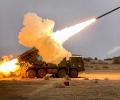
The rocket systems that were tested at Pokharan field firing ranges were manufactured by a private industry following transfer of technology by the Defence Research and Development Organisation.

The conversion facilitated range enhancement and improvement in Pinaka's accuracy.

'Professor Kitagawa is an exceptional researcher, a good teacher and above all a great person.'

'If you align your ambition with India's rise, the peak of your careers will unfold alongside the peak of India's power.'

A salvo from a Pinaka battery brings down on the enemy more than seven tonnes of high explosive in just 44 seconds.

The Laser-Induced Breakdown Spectroscope instrument onboard 'Pragyan' rover of Chandrayaan-3 has 'unambiguously confirmed the presence of sulphur in the lunar surface near south pole, through first-ever in-situ measurements,' ISRO said on Tuesday.

The country's largest stainless steel maker Jindal Steel (Hisar) on Wednesday marked its foray into the defence sector by forging a pact with DRDO for transfer of technology relating to high-nitrogen steel for armour applications.

The army has long been deficient in artillery, the modern battlefield's most lethal killer, says Ajai Shukla.

DRDO's Air Independent Propulsion system will allow Indian Navy submarines to operate for up to two weeks without having to surface to recharge its batteries.

10 non-bank and non-finance stocks from the BSE500 Index universe that offer an optimal blend of low valuation, reasonably robust revenue and earnings growth in recent quarters, a strong balance sheet, and most importantly, positive cash flow from their operations.

Project Vivaan won big at the Solar Decathlon, placing second overall (and missing the first position by a whisker). Members of the award-winning Team Shunya tell Mrigank Warrier how they built a carbon-neutral, water-neutral, energy-positive home for a family of four.

Professor Chintamani Nagesa Ramachandra Rao is the third scientist to be awarded the highest civilian award -- Bharat Ratna, a crowning glory of his inexorable list of outstanding achievements.

'No PM has said no to anything we have proposed. I am not a politician and I cannot give speeches about things, but a lot of good things have been done in science by previous governments.' 'Under Dr Manmohan Singh, we could do a few important things. I used to meet him once in 6, 8 weeks. He often said, 'Professor Rao, you assume that you have my approval and carry on.' He was shy and decent. He is a real gentleman.' 'Science keeps me going at 80. I feel young.' Professor C N R Rao, the eminent scientist who was honoured with the Bharat Ratna, on the state of science in India.

The Central Drugs Standard Control Organisation has granted restricted emergency use authorisation to two new vaccines and a drug for COVID-19, taking the number of preventives and treatments available in India to 12.

India has built two top-secret facilities in Karnataka to enrich uranium in pursuit of its hydrogen bomb dream.

Nanotechnology has remarkable applications in a variety of spheres, including agriculture, animal husbandry and natural resources management.

'It is in electronics that the gap between where we are and where we need to be is most obvious and most persistent.' 'It is not only a national security issue, but also a commercial issue,' argues Rajeev Srinivasan.
